
“Bio-Plastic: The Next Big Leap Towards a Plastic-Free Earth”
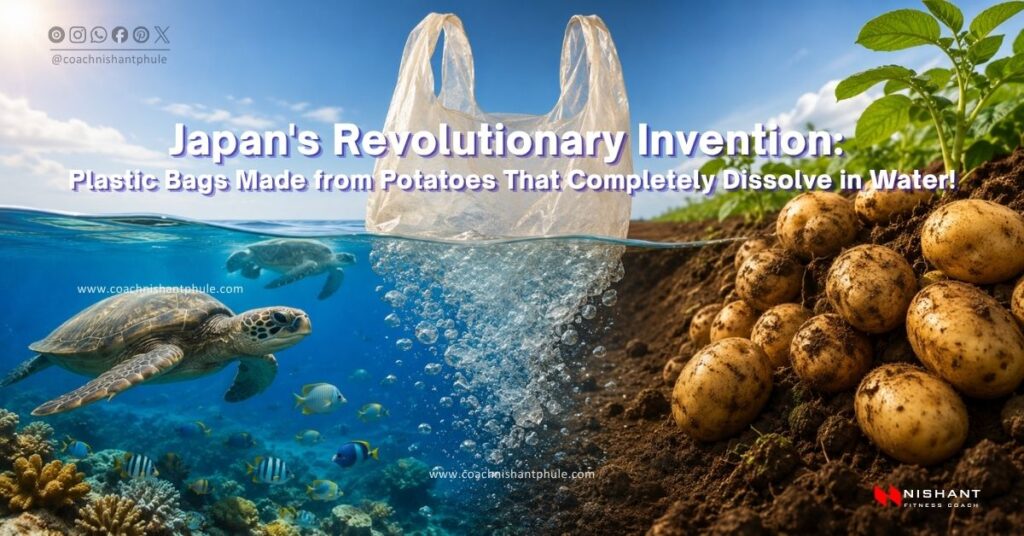
Today, the entire world is facing a major crisis due to plastic pollution. Plastic waste entering the oceans is particularly fatal to marine life. Every year, millions of fish, turtles, and seabirds lose their lives because of this plastic. In such a scenario, Japan—often considered the king of technology—has found a highly promising and eco-friendly solution to this problem. Researchers in Japan have developed Potato Plastic Bags using plant-based components, primarily potato starch. While they look exactly like regular plastic bags, they completely dissolve and disappear within a few days of coming into contact with water!
1. What Exactly is This Technology and How Does It Work?
Traditional plastic bags are made from petroleum-based chemicals, and it takes nearly 400 to 500 years for them to decompose in nature. However, Japan’s new technology falls under the biomass-derived category. These bags are manufactured using potato starch, sugarcane, and corn. When the bag comes into contact with ocean water or regular water, specific microorganisms living in the water begin to consume the natural components of the bag. As a result, the bag doesn’t just dissolve; it breaks down into water ($H_2O$) and carbon dioxide ($CO_2$), leaving behind absolutely no harmful chemicals.
2. Amazing Features of the Bio-Plastic Bag – Potato Plastic Bags
- Extremely Strong and Durable: One might think a bag made from potatoes would tear easily. However, researchers have designed these bags so that even though they are lightweight, they can easily carry weights up to 8 kg.
- No Risk of Microplastics: Regular plastic never fully disappears; it breaks down into tiny fragments that accumulate in the ocean, known as microplastics. These microplastics enter the stomachs of fish and eventually make their way into the human food chain. Since this Japanese bag completely decomposes, there is no risk of microplastic formation.
- 100% Safe Food for Marine Creatures: If a sea creature or a turtle accidentally swallows this bag mistaking it for food, it will not die. Being completely organic and natural, it is easily digested in the animal’s stomach just like regular food.
- Fast Decomposition Time: When disposed of in the sea or soil, more than 90% of the bag completely decomposes within approximately 180 days (6 months).
3. Key Japanese Institutions Behind This Discovery
Leading Japanese companies and research institutes have joined hands to bring about this revolutionary invention:
- Fukusuke Kogyo and Gunma University: ‘Fukusuke Kogyo’, a giant in Japan’s packaging sector, collaborated with Gunma University to bring this bag into the market for commercial use. – [https://www.gunma-u.ac.jp/english/](https://www.gunma-u.ac.jp/english/)
- RIKEN Research Institute: This national research institute of Japan has developed a type of plastic that begins to dissolve within just a few hours in seawater and turns into compost within 10 days if buried in soil.
- Kaneka Corporation: This company has created a completely plant-derived bio-polymer called Green Planet™, which is being used to manufacture straws, clothing, and bags.
4. Challenges and Hopes for the Future
While this technology is incredibly important for saving the Earth, it currently faces a few challenges. The cost of manufacturing these bags is currently 7 to 10 times higher than regular plastic. Therefore, it is difficult to implement its use immediately in poor and developing countries. Additionally, these bags can degrade quickly in damp or wet environments, requiring careful storage.
However, the Government of Japan and global environmental organizations are working on this on a large scale. In the future, when mass production begins, the cost will undoubtedly decrease.
Also Read: Beginner Workout Plans: Japan’s Revolutionary Invention: Plastic Bags Made from Potatoes That Completely Dissolve in Water!
Conclusion
Japan has set an excellent example before the world on how to utilize technology without harming nature. There is no doubt that this potato-based bag can play a massive role in keeping our rivers and oceans clean in the future!
